

WASAPI Exclusive
Desktop Concert path owns the DAC for low-latency, native-rate playback when the hardware allows.

Built for long exclusive soaks and a wet path that arrives at sample zero — not after the silence of a staggered boot.
Desktop Concert path owns the DAC for low-latency, native-rate playback when the hardware allows.
Custom buffering: large chunks, multi-fill, deep exclusive cushion — decode never under the audio lock.
Early Kernel FIR at sample zero. Loaded IR tails use uniformly partitioned convolution on Exclusive 44.1/48k and Shared; Exclusive 88.2 kHz and up keeps the 8-line FDN so the quantum stays clean.
Integer wet bus with wide accumulate — AVX when present. Designed sound, not float-and-hope.
Pro natural advance: next leg ready early, equal-power dry blend, wet soft rebuild. Default 0.3s.
Tape · Warmth · Console · Horn · Kernel · Limiter · Space — Concert defaults so the machine sounds like itself from Play.
Naught’s desktop Signature engine was not assembled from forum folklore. Fixed-point noise models, polyphase resampling, partitioned convolution, energy-preserving crossfades, and RT-safe threading sit on named papers and engineering briefs — the same lineage serious mastering and hi-fi engineers still cite.
Lore first — then step through the AES / JAES sources one at a time (Q30 wet bus, multiband tape, short early FIR + partitioned IR tail / FDN, dual-transport crossfade, lock-free refill). The browser Reliquary is a Concert-mapped approximation; the full integer / exclusive stack lives in the Windows build.
Most recordings from the last fifty years were mixed and mastered through analog consoles, tape machines, and large monitoring systems. Digital distribution often strips the last layer of harmonic richness and micro-dynamic glue. Naught restores that layer deliberately — not as nostalgia filters, but as a Signature path aimed at the control-room truth the mastering engineer heard when the master was approved.
The fixed-point path is built for blacker silence, sharper transients, and a deeper stage than typical float-and-hope chains. No six-figure console required — Exclusive when the hardware allows, Q30 wet bus, short early FIR, measured IR tail or FDN velvet, and a color stack (tape · console · horn · warmth · kernel · limiter) that behaves like a machine with a soul, not a pile of free VST defaults.
A short early FIR flavors the onset from a loaded IR. When the Exclusive deadline allows (44.1 / 48 kHz, or Shared), uniformly partitioned convolution (Gardner-family) carries the measured tail. Exclusive 88.2 kHz and up keeps the late network (Jot-style matrix, Dattorro-class diffusion, natural damping) so 96 kHz Exclusive does not blow the quantum — self-similar, not metallic, not “reverb plugin on a slider.”
Outside observers have described the desktop engine as closer to mission-critical software than to a typical media player — the same family of thinking you find in laboratory instruments, aerospace avionics, and telemetry processing. That is not a certification plaque. It is a statement about how the machine is allowed to fail — and that the path is deterministic when the gates are honest.
Determinism, here, is not a slogan. It means the same file, same settings, same Exclusive client, same device rate, should produce the same arithmetic through the Signature stack — not a slightly different float rounding each soak because the mixer, the scheduler, or a hidden resample changed its mind. Fixed-point (Q30 wide accumulate) keeps quantization a known, uniform property of the word size, not signal-dependent grain that wanders with level. Exclusive owns the endpoint so Windows cannot rewrite the stream — as close to the bare-metal as WASAPI Exclusive gets. Native rate when the DAC allows means no halfband “help.” The callback does not allocate, decode, or wait on a lock; refill happens on other threads. That is the same contract an instrument and a flight computer both demand: repeatable under load.
A lab instrument does not “feel” a sample and hope. It measures, accumulates in known arithmetic, and keeps the noise floor a property of the design, not of the last plugin that touched the bus. Avionics does not do surprise work on the deadline: the exclusive callback owns the quantum; decode, IR refill, and next-track prep live on other threads behind lock-free rings. Telemetry does not throw away the clock: rate match when the DAC allows, Exclusive so the OS mixer cannot rewrite the stream, fences and cache-aware writes so jitter stays a specification instead of a mood.
Naught was built on those reflexes. Q30 wide accumulate instead of float-and-hope. A short early FIR so the room still answers at sample zero. A loaded IR uses Gardner-family partitioned convolution where Exclusive has time (44.1 / 48 kHz and Shared); Exclusive 88.2 kHz and up keeps an FDN so the callback stays inside the quantum. Michael & Scott–class queues so the audio thread is never blocked for a refill. MMCSS / affinity so the callback stays a scheduled instrument, not a guest of the desktop. Oryaaaa-style memory hygiene so silicon is treated as part of the signal path.
Consumer players optimize for convenience. Mission-critical stacks optimize for bounded, deterministic behavior under load. Signature on is deterministic processing — the same color, the same space, every time. Dry + Exclusive + rate match + unity is the transparent lane. Naught is a listening machine that borrowed that ethic — not because a song is a flight computer, but because the silence between notes deserves the same respect a sensor channel gets when the reading has to be true.
That step from Dry to Wet is where Naught makes its case. Dry is not a disclaimer. Wet is not an apology. Together they shift the conversation off the analyzer plot and onto how hearing actually works — a room, a body, a pair of ears, not a flat file on a grid.
Dry is the integrity test. Exclusive, rate-matched, unity, Signature off: decoder passthrough. It proves the engine is not a sloppy color box that only sounds “good” because it is broken. A professional can measure the clean lane and see a serious player — then stop blaming the software and start listening to the recording. That baseline is the permission slip for everything that follows.
Wet is the calculated one. Tape glue, console and horn, kernel early energy, limiter as a ceiling, measured IR and late diffusion — not accidental hash. The stack is a deliberate attempt to put back the physical behavior digital distribution strips out: sound in a space, energy that has already met walls and air, presence that feels like listening in a room rather than inside a silent file. Headphones can make a “perfect” master sound artificially split and flat. The Signature path is built to feel inhabited.
Naught does not try to win a transparency war it never entered. Dry exists so the war can be declined honestly. Wet exists so the listener has to choose: a file that plots like a wire, or a wave that measures “worse” and behaves like a performance. Same master. Two truths. That dare — perceptual realism over a prettier residual — is exactly the argument the product was built to provoke.
Live music is the original ritual — air moving, bodies in a room, a performance that never repeats. Nothing software ships can replace that.
Naught is for the other sacred object: the fixed master. When the path is clean (Exclusive, rate match, Signature stack awake), the aim is the emotional truth of the recording as it was signed off — black silence between hits, transients that land like physical events, velvet tails that don’t grain out, forward intimacy without a digital veil. Live remains the source. Naught is the mirror for everything that only exists as a file.
Press Play and the chamber is not a flat stereo pane. Width and space are meant to bloom as a living envelope — early energy from the kernel, measured IR for the body of the room, late diffusion so decay never feels like a looped sample. The lattice on this site is the visual cousin of that idea: idle breath when nothing plays, signal-reactive when the track is live.
Sounds should feel carved from silence, not pasted on top of noise. Quiet passages bloom from a distance; dense moments hit with weight. It is not “3D headphone mode.” It is multi-axis placement and space design informed by real localization research (Blauert and company) — then engineered so the desktop path can hold it under load.
Same song. Same master. Yet long soaks on the Signature path can feel different night to night — not because the file changed, but because the machine is alive to energy, onset, decay shape, and how hard the lattice wants to manifest. Guitars snarl with new menace. Drums hit like impacts from another room. Tails stretch and shimmer with depth that feels revealed, not sprayed on.
That is the spooky performance. Not a randomizer for its own sake — a path designed so the recording stops sounding dead in the container and starts sounding like a room you could walk into.
Oryaaaa was a major inspiration on the path that became Naught. His approach to cache-aware writes, prefetch discipline, and treating the machine’s memory hierarchy as part of the listening ritual shaped how the desktop engine thinks about determinism — not only DSP math, but how samples move through silicon on the way to the DAC.
On the ship path that means Oryaaaa-style ideas wired in practice: non-temporal stores (cache-bypass writes on hot AVX paths), multi-block prefetch before streams, barriers and fences so the audio callback stays deterministic under Exclusive load. The goal is the same one the AES jitter literature points at — blacker silence, sharper transients, imaging that doesn’t smear because the OS and cache are thrashing underneath the music.
The full memory & CPU ritual (additive; dry path stays clean) is remembered as phases #1–#8 — Oryaaaa-style where his spirit leads, Naught-novel where the lattice needed its own moves:
Huge-page arena headroom (multi‑GB virtual IR space with graceful fallback) sits in the same family of thinking: fewer TLB misses, less jitter, longer IRs without the machine gasping. Respect to Oryaaaa — the inspiration is real; the Naught Exclusive + Signature stack is where those ideas were forged into a daily player.
Step through the lineage — one source at a time. Arrow keys work when this deck is focused.
Parallel fixed-point topologies and optimized quantization noise — the rationale for quiet multi-band tape chains instead of noisy cascade feedback stacks.
In Naught: parallel multiband tape structures aimed at lower quantization grain vs naive float cascades.
AES e-Lib →Shows how parallel IIR structures accumulate less noise than high-order cascade feedback — especially relevant to multi-band saturation chains.
In Naught: multi-band tape path prefers parallel band structure over one giant recursive stack.
Foundational result: fixed-point roundoff is uniform/white; floating-point noise is signal-dependent — the classic “modulation grain” argument for integer audio paths.
In Naught: Q30 fixed-point wet bus and wide accumulate — less float veil in tails and fades on the desktop ship path.
Extended fixed-point accumulators and careful recursive topologies for pro audio — still required reading for anyone who ships filters that must not “sing” at silence.
In Naught: extended-precision feedback in tape compression / roll-off stages on the Signature stack.
High-bit fixed accumulation beating 32-bit float on cumulative noise for mastering-class and convolution-heavy chains.
In Naught: wide fixed accumulation on the wet/integer path — designed for a dense FDN and color stack, not “float and hope.”
Energy-preserving amplitude laws for spatial positioning — the same constant-power intuition behind clean crossfades with no mid-dip hole.
In Naught: equal-power dual-transport crossfade (default ~0.3s) so track advances feel like analog DJ geometry, not a gain notch.
Polyphase decomposition and half-band FIR — the textbook foundation for phase-linear up/downsampling without aliasing/imaging garbage.
In Naught: polyphase / half-band structures for rate work and upsampling stages on the desktop path.
~6 dB noise improvement per extra fixed-point bit — the practical bit-budget argument behind wide Q formats.
In Naught: Q30 (and related wide accumulate) chosen for audible headroom in long wet chains.
Analog Devices →When deterministic audio paths prefer fixed-point — predictability, noise shape, and why “just use float everywhere” is not always the hi-fi answer.
In Naught: fixed-point advantage locked on the Signature wet path where it matters most.
Analog Devices →Fixed-point avoiding amplitude-dependent float noise and limit-cycle nastiness in biquad-class filters.
In Naught: filter topologies and extended acc aimed at black silence, not singing zeros.
RaneNote 157 →Uniformly partitioned convolution: block-FFT efficiency with direct-form immediacy — the paper that makes low-latency long IRs practical.
In Naught: first partition is the Kernel nose (sample zero). Later partitions are FFT overlap-save on Exclusive 44.1/48k and Shared. Exclusive 88.2 kHz and up keeps the FDN — measured 768-part UPC overran the 96 kHz Exclusive quantum.
Classic work on sampling-jitter thresholds — why timing discipline and clean exclusive delivery matter for transients and imaging.
In Naught: WASAPI Exclusive, RT-safe readahead, and callback hygiene so the path stays deterministic under load.
Definitive psychophysics of localization, reflections, and envelopment — why multi-axis spatial processing can deepen perceived silence via binaural unmasking.
In Naught: lattice / spatial stack and short early IR + FDN room informed by real localization cues, not only mono reverb soup.
Lock-free queue algorithms for real-time systems — the CS foundation for never blocking the audio callback on refill.
In Naught: background reverb / next-track / IR threads and ring handshakes so heavy work stays off the exclusive quantum.
These are the primary sources the desktop engine was engineered against — not decorative bibliography. Full shipping inventory is under Specs; Exclusive + Q30 + Kernel / partitioned IR / FDN live in the Windows download, not fully inside the browser chamber.
Naught Drift loads into the Reliquary playlist on arrival. Most browsers block autoplay — if you hear nothing, tap Start demo or ▶ Play in the chamber. Hit Demo anytime to bring the demos back. Drop your own audio to replace them and arm the lattice.
WAV · FLAC · MP3 · AIFF · OGG · M4A / AAC — multi-file playlist (clears demo when you load)
Browser ≈ Concert path · Exclusive · Q30 · full FDN stack = Windows desktop build
Default space IR: York Minster · courtesy of the OpenAIR Library (University of York · free-use attribution)
Guitar Cab IR: God's Cab (Mesa OS) by Signals Audio / Wilkinson Audio
Authoritative inventory for Naught Audio Player . The Reliquary above is a Concert-mapped browser approximation.
| Binary | NaughtAudioPlayer.exe · Windows x64 · JUCE 7 |
|---|---|
| Device | WASAPI Exclusive (Concert default) · Shared fallback · openWasapiOutput rebuild on mode change |
| Buffer / ups | 2048 samples default · upsample x2 ship (UI Off…x16) |
| Buffering | VoidBufferingAudioSource · 32k chunks · RT ring never decodes under lock · ~5s exclusive cushion @ ≥88.2k |
| Signature | Q30 wet path from block 0 · VoidKernel ON · multiband tape · Console · Horn · limiter · soft-clip dry |
| Space | Early Kernel (32 RT taps) · Gardner-family IR tail on Exclusive 44.1/48k and Shared · 8-line FDN on Exclusive 88.2 kHz+ · spatial / air stack |
| Transport | Pro dual-transport crossfade natural advance · gapless micro-seam not ship auto-advance |
| Threading | MMCSS Pro Audio · exclusive affinity 2–5 · readahead 0,1,6,7 · Auto prefers Ryzen 2–7 |
| Formats | WAV FLAC MP3 AIFF OGG M4A/AAC WMA OPUS · IR WAV/FLAC/AIFF-class |
| License | Free personal use (EULA) · Commercial: considerthecoin@protonmail.com |
Exclusive ON silences other apps on that device until Shared or quit. Toggling Exclusive mutes briefly, then auto-resumes when that mode is live (Exclusive ON only if Exclusive actually opened). Quit releases the device (closeAudioDevice).
Full Exclusive path, Q30 Signature stack, dual-transport crossfade, and RT-safe readahead. Two skins match this site: Luxury Warm (desktop default) and CosmoNaught Cyan (chamber identity). Same Concert path — different skin only. The Reliquary above is a browser approximation; this is the real machine.
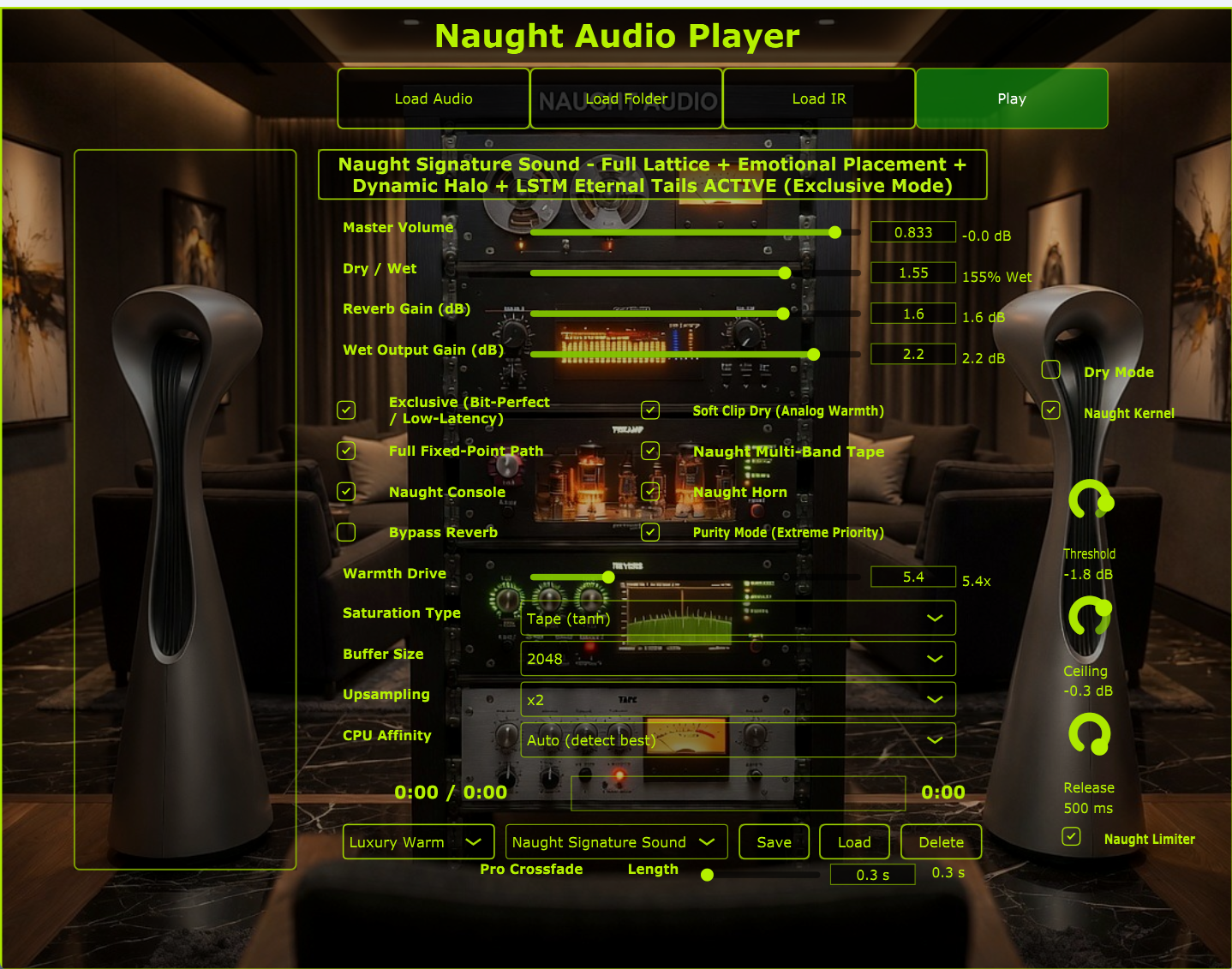
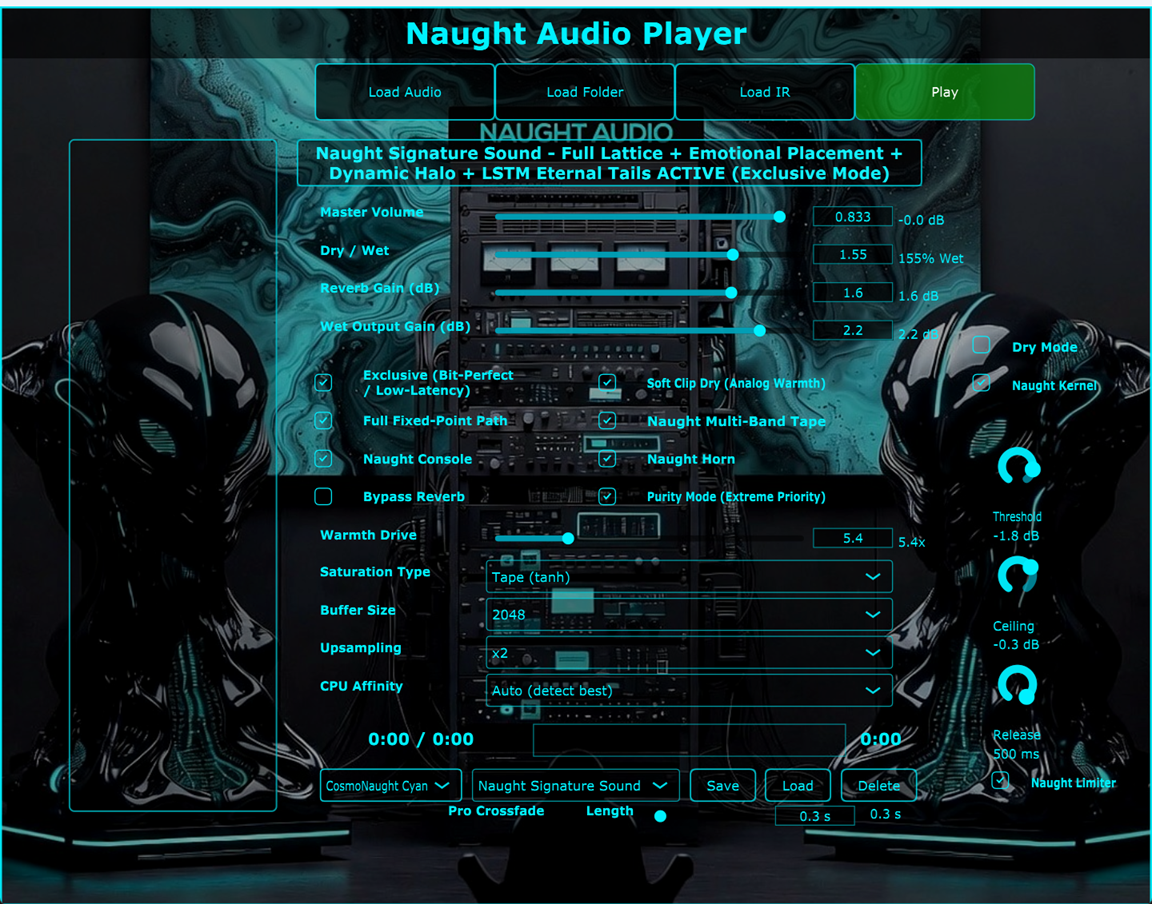
Thumbs load light — click either shot for full-size PNG. Same controls on both skins.
Windows x64 · latest release from the official repo.
Download Naught Audio Player
Commercial licensing:
considerthecoin@protonmail.com